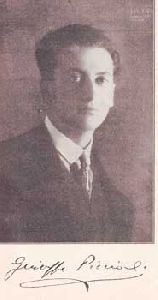
|
Born: August 5, 1905 - Bologna, Emilia-Romagna, Italy
Died: October 5, 1961 - Milano (Milan), Lombardy, Italy |
|
The Italian pianist, composer, arranger and musicologist, Giuseppe Piccioli, began studying piano at the age of 6 and at 12 he entered the Liceo Musicale di Bologna (now the Conservatorio di Musica Giovanni Battista Martini), where he graduated in 1921.
In 1923 Giuseppe Piccioli began his concert activity in Italy and abroad which he continued successfully until the early 1930's and then dedicated himself above all to piano teaching and composition. From 1932 he held one of the main piano chairs at the Liceo Musicale di Bologna and from 1952 until his death he taught at the Conservatorio di Milano.
Alongside his teaching activity, Giuseppe Piccioli also worked as a theoretician and historian, with texts on piano teaching and the history of musical forms. His historical musicological interest was initially realised in the recovery of Bolognese musicians from the Baroque period, then in the collaboration with the publisher Carisch for whom he started and directed, from 1937 until his death, the series Collezione di Musiche Sinfoniche Italiane dei Secoli XVII e XIX, producing numerous transcriptions and revisions of Italian musicians (Donizetti, Galuppi, Jommelli, Martini, Paisiello, Piccinni, Rossini, Salieri). The collaboration with the Sagra Musicale Umbra was fruitful and led over the course of a decade to the revision and performance of sacred scores by Cavalli, Leo, Perti, Rossi, Alessandro Scarlatti, D. Scarlatti, Stradella. Alongside these, he also wrote revisions and transcriptions of works (including Cimarosa's Il credulo, Salieri's La grotta di Trofonio, A. Scarlatti's Mitridate Eupatore and Tigrane) or Baroque chamber music (in particular Carl Philipp Emanuel Bach.)
Giuseppe Piccioli began his activity as a composer at a very young age with publications for piano and transcriptions, and devoted himself to larger compositions for orchestra or for piano and orchestra starting from Burlesca (1937) up to Sinfonietta concertante (1947) and Concerto for piano and orchestra (1950). For the theatre he composed two ballets: La tarantola (1942) first performed at the Rome Opera with choreography by Aurel Millos and Festa romantica (1943) first performed at the Wiener Staatsoper. He then wrote the incidental music for the fairy tale Cinderella (1948) on a text by Enzo Biagi, for Hamlet by Shakespeare (1952) directed by Squarzina (show broadcast in 1955 on Italian television, and for The Lord of Porcelgnac (from Monsieur de Pourceaugnac by Molière). |